
War is peace. Freedom is slavery. Ignorance is strength.
Showing posts with label Astronomy. Show all posts
Showing posts with label Astronomy. Show all posts
Friday, September 26, 2014


Friday, December 20, 2013
Temples in the shape of the sky ..." by photographer Luke Chapsi"

The given collection is unprecedented for the Greek data,as shown for the first time 14 archaeological sites of our country photographed the night for the needs of the Eugenides Planetarium show Heaven of the Ancients. "This valuable and impressive these photos the renowned photographer Luke Chapsi us show the starry night sky that stretches over the important archeological sites today.


Tuesday, October 22, 2013
Wednesday, February 27, 2013
Thursday, December 6, 2012
Tuesday, December 4, 2012
Moon phases for 2013
YouTube Description: This video shows the phases of the Moon for the entire year of 2013 on an hour by hour basis! It also shows various other items, like libration - the rocking around of the Moon due to its elliptical and tilted orbit - and physical data like distance, percent illuminated, and more. More info: http://svs.gsfc.nasa.gov/vis/a000000/a004000/a004000/ Video: NASA/GSFC Scientific Visualization Studio Music: Kevin MacLeod, "Heavy Interlude" and "Interloper", Incompetech.com
 Source
Sunday, June 10, 2012
"Tsunami in the Sky" Storm Cloud
The "Giant Wave" Supercell Pictures That Will Blow You Away
The results of the 2011 spring storm chasing season are in. Mike Hollingstead from Extreme Instability has been chasing storms for many years (his site is always a fascinating read for thrill-seekers). We featured his adventures before - see, for example, our article "Fog Storm Over Badlands". However this time, what you're going to see is going to blow you away - this is possibly the most epic sight on the whole Earth:

(image credit: Mike Hollingstead)
The collision of two supercells, resulting in the enormous "tsunami in the sky" storm front
With Mike Hollingstead's exclusive permission, we present to you June 19, 2011 McCook Nebraska Supercell:

Mike suggests playing "Exogenesis Symphony Pt 1: Overture" by Muse, while looking at these pictures... "If the storm could pick a song to have playing for it, it would pick that song.":

The results of the 2011 spring storm chasing season are in. Mike Hollingstead from Extreme Instability has been chasing storms for many years (his site is always a fascinating read for thrill-seekers). We featured his adventures before - see, for example, our article "Fog Storm Over Badlands". However this time, what you're going to see is going to blow you away - this is possibly the most epic sight on the whole Earth:
(image credit: Mike Hollingstead)
The collision of two supercells, resulting in the enormous "tsunami in the sky" storm front
With Mike Hollingstead's exclusive permission, we present to you June 19, 2011 McCook Nebraska Supercell:
Mike suggests playing "Exogenesis Symphony Pt 1: Overture" by Muse, while looking at these pictures... "If the storm could pick a song to have playing for it, it would pick that song.":
Saturday, May 19, 2012
Extreme & Beautiful Weather
Majestic Skies Created by Powerful Storms
Since our last "Mammatus, Lenticular & Other Extreme Clouds" article, the good old Nature kept giving the photographers great opportunities for stunning shots. Problem is, great celestial displays are often followed by some nasty storms... which hardly anybody would want to witness firsthand.
We'll start with a "Clouds Beauty Contest". Most sources are listed directly under the photos, though some original credits remain unknown. We mentioned "Clouds Appreciation Society" as a premier destination for cloud-watchers & photographers before, and it remains the "one-stop" website with more and more spectacular submissions every day. Among the other sources of this article, you will see a few examples out of thousands worthy pictures displayed there.
Cloud "Explosions" - Cumulonimbus cloud formations, building up to powerful storms.


(photos credit: Karen Titchener, Cloud Aprreciation Society)
Since our last "Mammatus, Lenticular & Other Extreme Clouds" article, the good old Nature kept giving the photographers great opportunities for stunning shots. Problem is, great celestial displays are often followed by some nasty storms... which hardly anybody would want to witness firsthand.
We'll start with a "Clouds Beauty Contest". Most sources are listed directly under the photos, though some original credits remain unknown. We mentioned "Clouds Appreciation Society" as a premier destination for cloud-watchers & photographers before, and it remains the "one-stop" website with more and more spectacular submissions every day. Among the other sources of this article, you will see a few examples out of thousands worthy pictures displayed there.
Cloud "Explosions" - Cumulonimbus cloud formations, building up to powerful storms.
(photos credit: Karen Titchener, Cloud Aprreciation Society)
Mega Earthquake and Tsunami
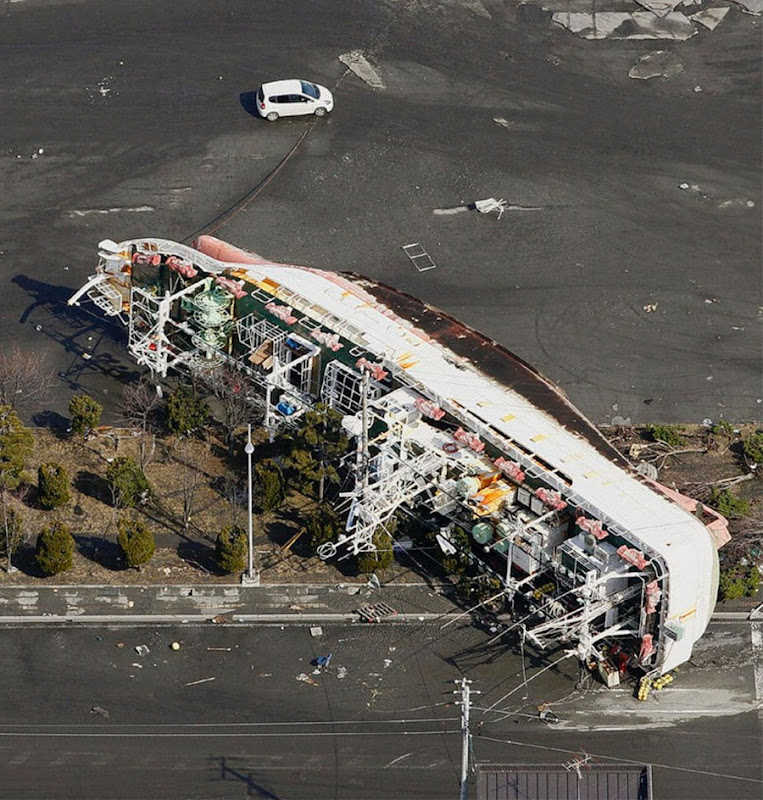
We've briefly touched on this topic in Future Plate Tectonics, yet with another huge wake-up call earthquake (and continuing swarm of smaller quakes) in Japan, we feel we should cover this kind of apocalyptic natural disasters more broadly, as well as raise awareness about horrific conditions for people in North Japan right now.

(a house drifts the ocean after being swept away by tsunami, image via)
Thousands of people are left without shelter and means of transportation in the wake of combined earthquake/tsunami disaster - in freezing cold, with dwindling supplies (many stores display empty shelves, which is quite an unusual sight for Japan). Please keep Northern Japan in your thoughts, and help by donating through a respectable company - Google - at this link.
(images via)
The earthquake in Japan was so strong (the fifth strongest since 1900) that it even sped up the Earth's rotation by 1.6 microseconds, causing a day to get slightly shorter - more info
And the earthquakes continue in this "Ring of Fire" zone. It almost became a non-event to feel 6.0 aftershocks in Japan today... However, remember that a 9.0 earthquake is 1000 times worse than a 6.0 scale earthquake - the Richter Scale is logarithmic.

(images via)
---
(a house drifts the ocean after being swept away by tsunami, image via)
Thousands of people are left without shelter and means of transportation in the wake of combined earthquake/tsunami disaster - in freezing cold, with dwindling supplies (many stores display empty shelves, which is quite an unusual sight for Japan). Please keep Northern Japan in your thoughts, and help by donating through a respectable company - Google - at this link.
(images via)
The earthquake in Japan was so strong (the fifth strongest since 1900) that it even sped up the Earth's rotation by 1.6 microseconds, causing a day to get slightly shorter - more info
And the earthquakes continue in this "Ring of Fire" zone. It almost became a non-event to feel 6.0 aftershocks in Japan today... However, remember that a 9.0 earthquake is 1000 times worse than a 6.0 scale earthquake - the Richter Scale is logarithmic.
(images via)
---
Stunning Art of Ancient Calendars
Egyptian & Mayan-Aztec Calendars: Incredibly Sophisticated Earliest Works of Art
We are continuing our historical art overview (see for example, our "Mysterious Non-Egyptian Pyramids"), this time going all the way back to the beginning of the recorded history. Around 5,000 BC first calendars made their appearance, and set the standard by which we measure our months and days today.
Regardless of what you think about Mayan Calendar concerning 2012, you have to admit their representation of time flow was simply stunning:


(images via 1, 2)
This is the Aztec Calendar, on display at the Museo Nacional de Antropologia in Mexico City, Mexico: it's a huge basaltic monolith (it weighs 25 tons), Aztec called it Cuauhxicalli Eagle Bowl, but it is universally known as the Aztec Calendar or Sun Stone.
"The Mayans see time like a river. The Mayans also see changes in time as differences of tones, frequencies or even octaves, not just a hard measurement of something that never changes."

(images credit: Coppersmith Victor Bono, Olga Utlyakova)
Time Out of Time
One of our readers writes "I have a little replica, it's fantastic. Every year has a "no time" period - days "outside the calendar", to freely celebrate life." Well, actually, there are in total five "Nameless Days" (more info) at the end of every Mayan solar year - so called Wayeb'"Time Out of Time", a period for transition and preparation for the next year. Beside the obvious "free time" aspect, these days were considered sacred and quite mysterious "Days of Awe":
"During Wayeb, portals between the mortal realm and the Underworld dissolved. No boundaries prevented the ill-intending deities from causing disasters." For those interested, in 2012 the Wayeb period falls on March 28 - April 1 (source).
We are continuing our historical art overview (see for example, our "Mysterious Non-Egyptian Pyramids"), this time going all the way back to the beginning of the recorded history. Around 5,000 BC first calendars made their appearance, and set the standard by which we measure our months and days today.
Regardless of what you think about Mayan Calendar concerning 2012, you have to admit their representation of time flow was simply stunning:

(images via 1, 2)
This is the Aztec Calendar, on display at the Museo Nacional de Antropologia in Mexico City, Mexico: it's a huge basaltic monolith (it weighs 25 tons), Aztec called it Cuauhxicalli Eagle Bowl, but it is universally known as the Aztec Calendar or Sun Stone.
"The Mayans see time like a river. The Mayans also see changes in time as differences of tones, frequencies or even octaves, not just a hard measurement of something that never changes."
(images credit: Coppersmith Victor Bono, Olga Utlyakova)
Time Out of Time
One of our readers writes "I have a little replica, it's fantastic. Every year has a "no time" period - days "outside the calendar", to freely celebrate life." Well, actually, there are in total five "Nameless Days" (more info) at the end of every Mayan solar year - so called Wayeb'"Time Out of Time", a period for transition and preparation for the next year. Beside the obvious "free time" aspect, these days were considered sacred and quite mysterious "Days of Awe":
"During Wayeb, portals between the mortal realm and the Underworld dissolved. No boundaries prevented the ill-intending deities from causing disasters." For those interested, in 2012 the Wayeb period falls on March 28 - April 1 (source).
Thursday, May 10, 2012
Milky Way over the desert
Against the backdrop of endless space and the beautiful Milky Way in particular, our planet seems a little toy. Truly beautiful and great space!

Milky Way in the night sky over the National Park, Arches, Utah, USA. Photographer Brett Webster uses the night sky, the national parks in his native Utah, as a canvas to create images that reflect all the pettiness of our planet in comparison with the great cosmos. (BRET WEBSTER / BARCROFT USA)

“I really like the Utah desert, I was always amazed Park Arches and Canyons,” – says Brett, who spent 27 years as a rocketeer and expert on the propeller in the company «Northrop Grumman». In the photo: a long arch in the park against the backdrop of the Arch of the Milky Way. (BRET WEBSTER / BARCROFT USA)

Tuesday, May 8, 2012

Ancient Greek Goddess Athena is highlighted by the moon in Athens on May 6

Thursday, April 26, 2012
World's oldest computer
This documentary investigates the Antikythera Mechanism, a computer-like device that may have been used to calculate the movements of stars and planets. It also highlights ancient inventors Archimedes and Ctesibius. The Antikythera mechanism is an ancient mechanical computer designed to calculate astronomical positions. It was recovered in 1900--1901 from the Antikythera wreck. Its significance and complexity were not understood until decades later. Its time of construction is now estimated between 150 and 100 BC. Technological artifacts of similar complexity and workmanship did not reappear in Europe until the 14th century, when mechanical astronomical clocks were built in Europe. Jacques-Yves Cousteau visited the wreck for the last time in 1978, but found no additional remains of the Antikythera mechanism. Professor Michael Edmunds of Cardiff University who led the most recent study of the mechanism said: "This device is just extraordinary, the only thing of its kind. The design is beautiful, the astronomy is exactly right. The way the mechanics are designed just makes your jaw drop. Whoever has done this has done it extremely carefully ... in terms of historic and scarcity value, I have to regard this mechanism as being more valuable than the Mona Lisa." The device is displayed at the National Archaeological Museum of Athens, accompanied by a reconstruction made and donated to the museum by Derek de Solla Price.
Monday, March 19, 2012
Evolution of the Moon
From year to year, the moon never seems to change. Craters and other formations appear to be permanent now, but the moon didn't always look like this. Thanks to NASA's Lunar Reconnaissance Orbiter, we now have a better look at some of the moon's history. Learn more in this video!
Saturday, March 17, 2012
Tuesday, March 6, 2012
Long-Exposure & Time-Lapse Photographers

Andrew Stawarz


(images via: Andrew Stawarz)
Andrew Stawarz is a British photographer who takes stunning long exposure photos of urban scenes in England. Using a Nikon D300, Stawarz creates eerie, colorful images that manage to make scenes like power plants and control towers undeniably beautiful.
Sara Heinrichs


(images via: Sara Heinrichs)
In Sara Heinrichs’ long-exposure photo of a ride at a carnival, the spinning wheel in its hues of pink, green, blue and yellow almost looks like a UFO made of candy. Heinrichs also uses the long exposure technique to create an image with ghostly silhouettes against an ocean sunset background. She stood in front of the camera and held each pose for about five seconds during the 25-second exposure.
Subscribe to:
Posts (Atom)
